

Siddhar’s Grace and the Hunger for Wisdom
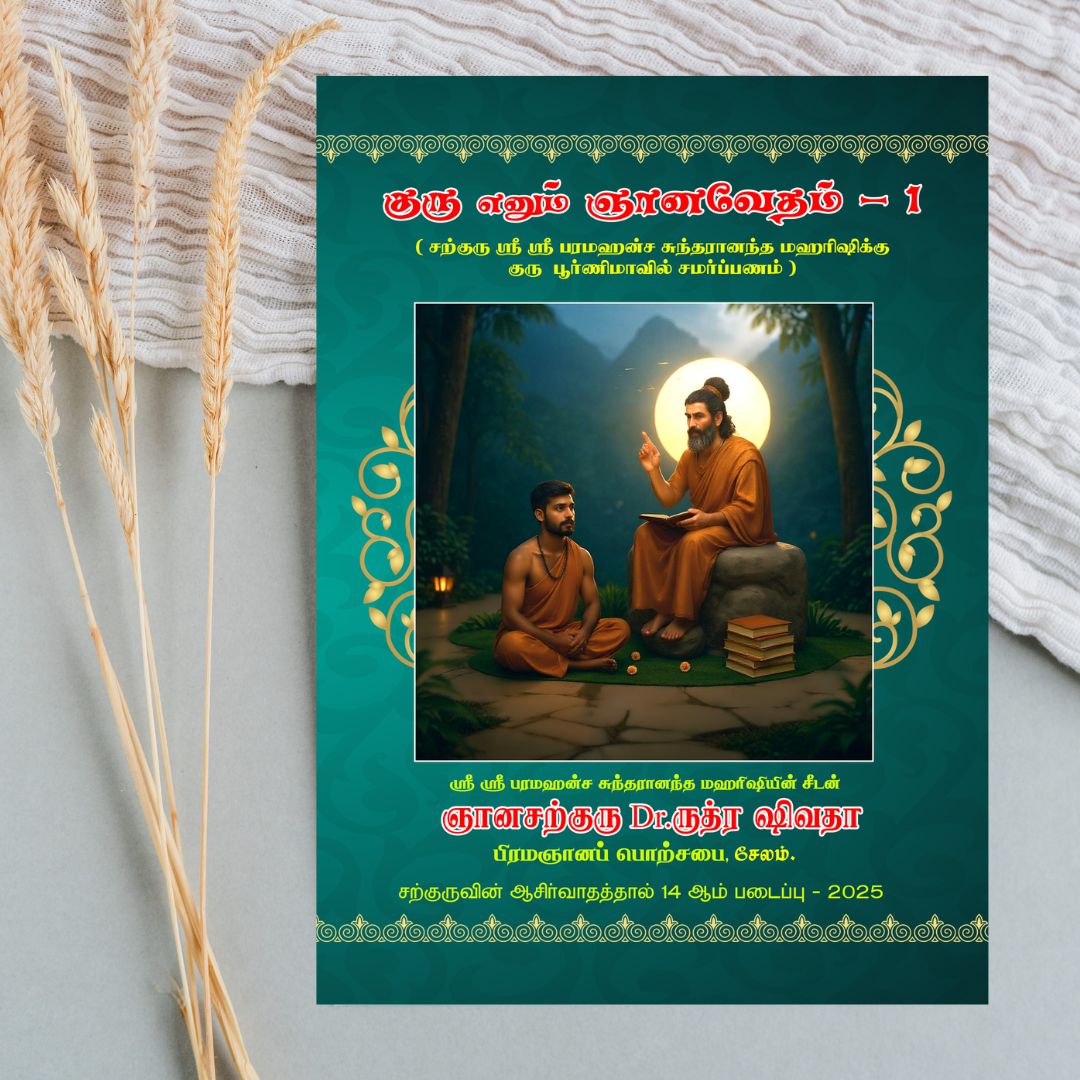
We bow in reverence at the golden holy feet of Sri Sri Paramahamsa Sundarananda Maharishi of Sathuragiri, who, like the primordial Tamil Siddhars, bestowed upon us the most wondrous supreme wisdom of Brahma Gnana by taking possession of our soul and life. On the occasion of Guru Purnima (10.07.2025), we offer these flowers of knowledge—the sacred scriptures of wisdom named “Guru”—at his feet.
It was in 1988 that the Guru first took hold of me. That year, it happened on a full moon day. At that time, I was practicing the pranayama techniques of Kadappai Satchidananda Yogiswarar for four hours daily—two sessions, morning and evening. Food was only once a day; three meals were impossible. The reason was that the prana energy from the pranayama practice spread throughout the body, making multiple meals unnecessary. Those were also days when the goddess of poverty had taken hold of me, leaving me without even a single meal for many days. I was 21—youthful days.
As our mother Avvai has said:
“Poverty is cruel, cruel indeed; yet even more cruel is poverty in youth.”
In that youthful stage, I struggled immensely even for one meal a day. I could not go begging for food. There were many days sustained with nothing but a single banana. Those were days when I saw with my own eyes the impermanence of the body. At times when I had no rice to eat, my talk was only about Vallalar and the Siddhars.
During long stretches when food was unavailable, reciting Thiruvarutpa Agaval itself became my food. It took nearly three hours to complete a full chanting of the Agaval. By the time I finished, the burning hunger would vanish. It took me a month to realize this truth.
In those days when I had no shelter, it was Mr. Chandran Achari of Dhammampatti (Salem district) who gave me a place to stay in Vallalar’s temple. If not for him, I would not have found a place to stay, food to eat, or even a teaching job at a matriculation school with a salary of Rs. 300.
The Guru Who Entered Like the Wind
For nearly three years, I lived in Vallalar’s temple in our village. Morning and evening, the chanting of Agaval resounded there. Since the temple construction was complete but not yet opened, I had the space to stay there. Daily, I would clean the place with water, light a lamp before Vallalar’s idol, and recite the Agaval. It was this elder, Sri Chandran Achari, who directed me towards Vallalar’s path. I will always remain indebted to him. Even today, whenever I sit down for a meal, it is my habit to remember him in gratitude.
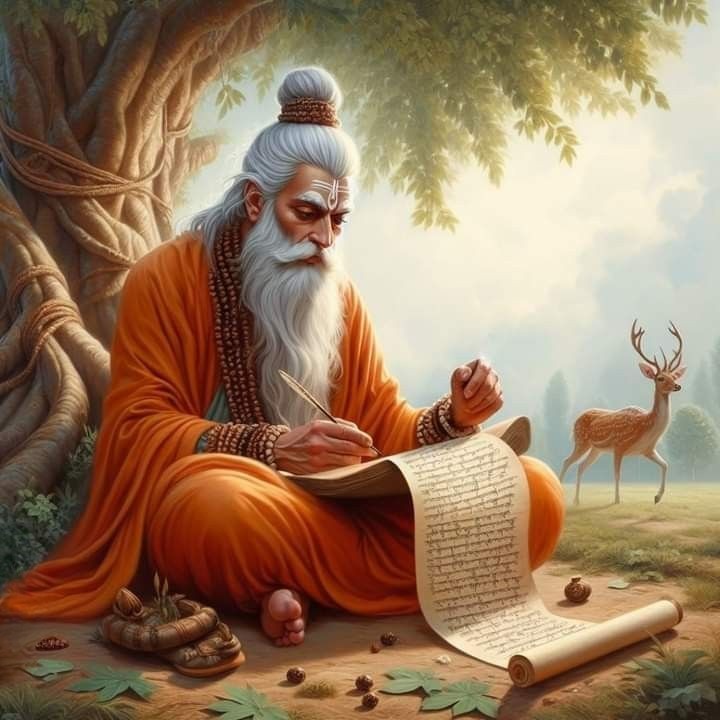
In the early mornings, I would practice pranayama as taught by Kadappai Satchidananda Yogiswarar. After that, I would chant the Agaval. This continued for three years. It was during this time that my Satguru, Sundarananda Maharishi, came into my life and possessed me.
I had the habit of locking the temple door from inside before beginning pranayama. The Guru first revealed himself by entering inside like air seeping through a lock and sitting before me, watching my yogic practices. When I felt as though someone was observing me, I opened my eyes, and there he was, seated before me.
I asked him many questions: “Who are you? How did you enter through a locked door? What are you doing here?”
He simply said, “Like this,” stood up, passed through the locked door as if flowing out as air, and then re-entered in the same way. I was utterly shocked. I wondered, “Is he a man? Or some kind of sorcerer?”
For many days, he continued appearing inside the locked door, watching my yogic practices. One day, he asked me:
“Brother, why are you doing all this yoga practice? Why waste your youthful life in solitude? Shouldn’t you be out there enjoying yourself like other young men?”
My mind wanted to retort, “Why should it matter to you what I do? Who are you to question me?” But I could not speak so dismissively to him.
“I did not receive the care and affection of a mother or father. But because of that, I have no desire to make this body, which is the living abode of God, into a dustbin for throwing away filth. Like the saints and Siddhars, I wish to live a life of grace, and finally merge with God. I should not be born again to suffer in poverty like this, weeping for food. If I live, it must be with God; if not, then with Yama (the lord of death).”
He replied:
“Ah, is that so? At such a young age, you speak like ripe wisdom! Good, my son. Will you come with me? I will show you God. Then you can live forever with Him, with endless bliss that never diminishes.”
I asked doubtfully:
“Is that possible, sir? Can one really see God?”
He said:
“At first, it may seem difficult. But with practice, it will become natural, like second nature. If you have the unquenchable thirst and longing to see God, I can show Him to you, make you experience Him directly.”
I said:
“Given my present state of mind, it is hard for me to believe this is possible.”
He said:
“Then I will make you feel and realize Him right now. If possible, see God for yourself.”
“How? In what way is that possible?” I asked.
“Sit down. Fix your gaze at the point between your eyebrows—the third-eye point,” he instructed.
I did as told.
At once, his radiant, piercing eyes began to gaze deeply into mine. Since he had already told me not to blink, I kept staring steadily at his eyes.
After about 15 seconds, he disappeared before me. Only his eyes remained, floating in the air, speaking to me. The place where I sat seemed to be slipping away. Soon, I could no longer see where I was sitting. The windows, walls, and doors of Vallalar’s temple vanished. The temple itself disappeared. Suddenly, I was sitting before a waterfall on top of a mountain.
“Enter the waterfall,” he said. I went inside.
“Do you see a cave within?” he asked.
“Yes,” I replied.
“Is there a lamp burning inside?”
“Yes, a lamp is there,” I said.
“Go and sit there. Fix your entire attention on the spot I direct you to, and remain in complete stillness.”
From then on, no thoughts arose in me. My mind did not wander. As he said, I sat before the lamp, staring steadily into its flame without blinking.
Then I began to hear voices, as though people were speaking. The fragrance of camphor wafted through. Along with it came the scent of fragrant flowers—screw-pine, jasmine. Suddenly, the entire cave was filled with these divine fragrances. Thoughts of many kinds began to arise within me.
“My son, no thoughts should arise in you. If they arise, kill them at once, then and there,” said the Guru.
Kill thoughts? I did not know how. But I understood that he meant not to let any thoughts take root. So I continued fixing my mind only upon the lamp.
Just then, a snake came slithering swiftly before me and stopped, staring straight at me.
“What is this misery? I trusted this man and came here, and now snakes are crawling in this cave—what am I to do?” I thought in despair.
“My son, fix your entire attention upon the snake,” he said. I did.
The snake, staring at me, slowly began to climb onto my body. “Oh no! What kind of trial is this? Surely the snake will bite me. Perhaps it will even take its time, biting me again and again. Lord, save my life, Lord, save my life!” My body broke into a sweat as I trembled inside, praying in fear.
The snake climbed up, coiled around my neck, and came right before my eyes, staring into them.
“Ah, so this is it! The snake has found no other place to strike—it is going to bite me in the eyes!” I thought, trembling with fear. I could see nothing else—only the snake. The cave, the fragrances, everything vanished. In that cave, it seemed there was nothing else but me and the snake.
Inside, I kept crying, “Sir, where have you gone? Please save me from this snake.”
No answer came from him. My mind began to think in fear, “What is this? Why has he left me trapped with this snake?”
Then something within me whispered: “Fix your gaze on the snake’s eyes.”
Anyway, the snake is going to bite me, and I am going to die. At least let me die peacefully. With that thought, I began to look into the snake’s eyes.
In its eyes I saw a radiant brilliance, like a band of diamonds. The intensity of that gaze was sharper even than Garuda’s fierce look. As I stared into its eyes, the snake’s body disappeared, leaving only its eyes visible to me.
From those eyes, a yellow light began to swirl and stream out, like rays of fire. They were like the rays of sunlight falling upon the earth. Not knowing why the snake was emitting these yellow rays, I focused my attention upon them—and the next instant, I vanished. My body disappeared. My thoughts vanished. In the place where I had been sitting, there remained only a single light, like the glow of a small lamp.
The light from the snake’s eyes began to merge with this lamp-like glow. Suddenly, a single divine eye appeared there. I stood transfixed by its beauty, unable to turn my gaze away. My sight was locked upon it.
The effects of the knowledge born of the snake’s light merging with the lamp’s light were beyond measure.
Then I heard my Guru’s voice: “My son…”
I tried to speak, but I could not. I could not even think.
“This is the house of God. Look closely at the central point of this house of light. There, see a single luminous particle shining with the brilliance of a crore (ten million) suns. That is God. That light is His body. Can you see that light clearly?” he asked.
Now I could think a little. “Yes, Sir,” I said inwardly.
Then I felt someone press the crown of my head with a hand. The little thought remaining in me dissolved. Now the snake’s eyes had disappeared; their light joined with another light, swirling together.
“My son, do you see yourself in that light?” he asked.
As soon as he finished speaking, I found myself sitting there again in my gross body. Before me, the yellow light still glowed.
“Go inside it, my son,” he said.
I went. Entering the yellow light, it vanished, and I began to see a vast empty space shaped like a sphere—the world-globe. It was as though the entire universe were filled with golden light.
After a while, I saw the upper half of Lord Murugan’s vel (spear) head, glowing red, approach from the left and reach the center of that vastness. The next instant, from the right, the other half of the vel head, also fiery red, came and joined it. The full spearhead of the vel now stood revealed. I kept looking steadily at the red vel.
“My son, this is the abode of your soul. Look carefully. Within it, is a white light shining?” he asked.
“Yes, Sir,” I replied.
“That is God. That white light is God’s form. This is what is meant when people say God is light. The red vel you see within yourself is Lord Murugan. Murugan’s full grace is upon you. For one to become a Siddha, the grace of Murugan and of Mother Valai (Valli) is absolutely necessary. Usually, only after Murugan appears does Valli show herself. But for you, it is after Valli showed herself that Murugan has appeared and blessed you,” he said.
“I have not yet seen Mother Valli, Sir. You must be mistaken,” I thought to myself, yet I remained absorbed in the vision of God.
“My son, it was Valli who first came and took hold of you. It was at her instruction that I came to meet you in your town. All this is a play directed by her. Within you now resides Mother Bhuvaneshwari Herself,” he said.
I thought within myself, “Sir, I have never seen either of them till now.”
He said, “My son, on the very first day you began your Hatha Yoga practice, did not a little girl of about five years come running, climb onto your back, laugh joyfully for a long time, and play? Did she not come and sit on your lap, stroking your cheeks and your head with affection?”
I was astonished. “How could he possibly know this? I never told anyone out of fear.”
He asked, “Why do you not answer?”
“Yes, yes, Sir. How do you know of this?” I asked.
“She is sitting within you in the form of light, telling me herself. She compelled me to reveal this to you. She is none other than Mother Minakṣi, the form of Matangi; she is also Mother Bhuvaneshwari. Today, it was she who came before you in the form of the snake and enacted these divine plays. She is Mother Valli herself. The Naga Sparsa Dikṣa (serpent-touch initiation), which is granted only to great Siddhas, has now been bestowed upon you. Even to me, this is a great wonder.
I had come here intending to give you initiation. But before I could, Valli Herself possessed you and granted you the Brahma Netra Dikṣa (initiation of the Divine Eye). She has taken you entirely under her care. I have been commanded only to teach you the complete science of Brahma Jnana.
My son, do not be anxious. From now on, you shall only gain victory in wisdom. Now listen carefully as I point out the seat of that white light, the central point. There, within you, is the abode of God—the Citrambalam. At that place, you must ever behold the blissful light, witness its eternal dance of joy, and perform your tapas of Brahma Jnana.”
Saying so, he led me to the Chathuragiri Hills. There, for five years, he sustained me without any grains or regular food—only with herbs as nourishment—while imparting to me the supreme teachings of Brahma Jnana.
That supremely compassionate Satguru, higher to me than life itself, was none other than Sathuragiri Siddhar Sri Sri Paramahamsa Sundarānanda Maharishi.
By his grace, blessings, and divine command, since 2021 we have been continuously writing and speaking about the Brahma Jnana Vidya of the ancient Tamil Siddhas. Through our website, discourses, and Gurukula-style teachings, we have been instructing students in the timeless spiritual education of the Siddhas.
It was he who sowed within me the seed of Brahma Jñāna and nurtured it to bear rich fruit. To that magnanimous giver of Brahma Jñāna, the benevolent master of wisdom—Sathuragiri Siddhar Sri Sri Paramahamsa Sundarananda Maharishi—we bow our heads in reverence at his golden feet and joyfully dedicate this Jñāna Veda.
Truly, all is only by the Guru’s grace. This too is but his divine play.
The Glory of the Guru
The Muṇḍaka Upanishad declares:
“Take refuge in the Guru who holds the sacred firewood in hand, who is both well-versed in the scriptures (Srotriya) and firmly established in Brahman (Brahma-niṣṭa), for the sake of realizing the Self.”
According to this statement, the Guru who has attained clarity in the meaning of the Sruti scriptures and who abides in Brahman is the one in whom the divine power (sakti) of God shines forth in a special way, more than in any other place.
The burning power of the sun is spread everywhere, but by itself it does not ignite cotton or other things directly. Yet, when sunlight is gathered through a magnifying glass, it focuses and burns.
Likewise, though the power of God pervades everywhere, it manifests itself in a concentrated and effective way through the realized Guru, burning away the triple impurities (mala-traya) of the disciple who stands before him. By no other means can these impurities be destroyed completely.
Similarly, though sunlight naturally illuminates the earth and universe, when it falls upon mirrors, water, or shining plates, it reflects with great brilliance, strong enough to dispel even deep darkness. In the same way, the divine essence of God, though all-pervasive, shines forth in a unique and concentrated manner through the realized Guru, dispelling the inner darkness of ignorance and revealing the subtle spiritual body of the disciple. By no other way can the darkness of the heart be removed.
Because of this, even if one worships God directly and has His vision, one may attain some powers (siddhis) according to one’s needs, but one cannot by that alone reach the state of jivanmukti (liberated while living). But if, by God’s grace, one approaches a realized Guru, stands near him, and listens at his left side, the Guru will bestow the true teaching (upadesa). In no other way will the disciple receive it. Hence, listening in the presence of the Guru’s body is even more powerful than approaching God directly. This truth is explained in verses 88 and 343 of this work.
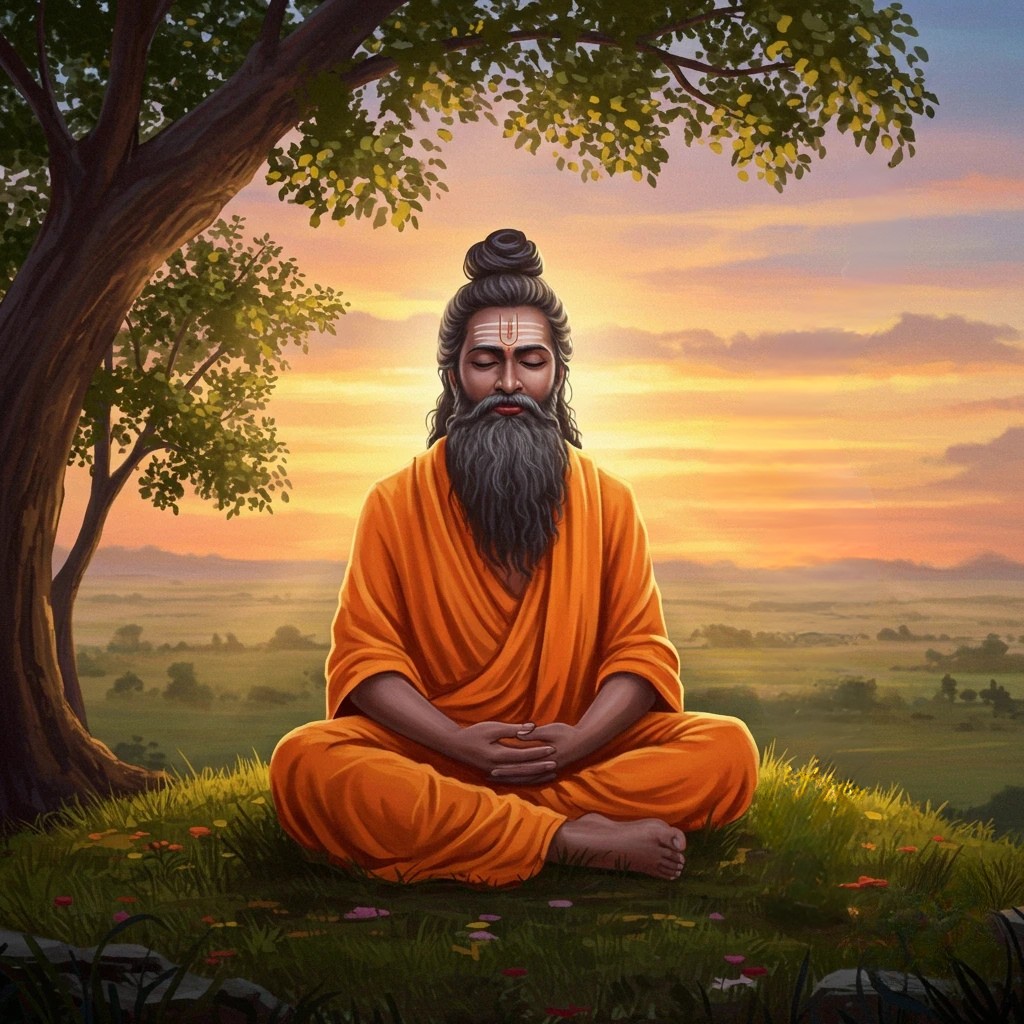
Worship of God directly brings merit (punya) and auspicious results. But worship of God in the form of the Guru not only brings merit, it also grants liberation from ignorance (the triple impurities) through the Guru’s teachings, received by the grace shining from his presence. The disciple thus experiences measureless bliss and the realization of the Self. For this reason, the Guru’s form is greater than the form of God.
Even when God does not reveal Himself directly, His divine power (sakti) enters the body of the realized Guru like an electric current through the crown of the head (dvadasanta) and radiates with supreme brilliance. Some part of this power also flows outward through his feet.
Therefore, those who wish to surrender to God, dedicate their lives to Him, and receive His grace must serve and bow at the feet of the Guru. Through the power radiating from his feet, they will receive every blessing and prosperity.
When one bows at the Guru’s feet, his divine power enters the devotee through the crown of the head, the bhrumadhya (between the eyebrows), the chest, the throat, the fingertips, and other points of the body.
If one acts in accordance with the Guru’s will, then by his abundant compassion, the power of his sight, the touch of his hand upon the disciple’s head, his thought “May this one prosper,” and his blessings—the Guru’s divine power enters and transforms the disciple.
Guru Dikṣa – The Graceful Look of the Master
It is said: “When the Guru, out of compassion, looks upon the disciple with the intent of removing his sins, that itself is called Guru Dikṣa.”
Such a dikṣa from the Guru bestows upon the disciple the state of pure knowledge (vimalam).
“Vimalam” means freedom from impurity. Through Guru Dikṣa, the karmic impressions (karma-vasanas) of the disciple are burnt away.
That is why the Vedas and Upanishads proclaim that the Guru’s compassionate look is truly Guru Dikṣa.
If the karmic impressions of a disciple are not destroyed by the compassion of a Guru, then such a person cannot truly be called a Guru.
When the spiritual disposition (sarva-bhavana) of the Guru increases, the divine power of God (isvara-sakti) manifests through him more intensely. Just as a blazing flame shines far brighter than a small lamp, so too does God’s power shine more brilliantly through such a Guru.
Because of this, the scriptures declare with one voice that the Guru alone is supreme. Apart from the Guru, there is absolutely no other way and no other place by which a human soul can attain jivanmukti (liberation while living). This truth is proclaimed in this scripture as well as in the Vedas, Agamas, Puraṇas, and Itihasas.
Therefore, for all people in the world, of whatever religion or background, devotion to the Guru (guru-bhakti) is of utmost necessity.
And if one seeks to cultivate such devotion, a simple yet powerful means is this:
By reading this sacred text daily, by allowing its merits to purify one’s mind, and by constantly remembering the glory of the Guru that shines through its words, devotion to the Guru will naturally blossom within.
The fruits of such devotion are boundless.
May Guru’s love and God’s love ever remain within us.