

There are countless poems in this world filled with divine essence. Among the world’s literary treasures, if there are any that embody complete spiritual wisdom, it is only our sacred Tamil scripture, the Thiruvasagam — sung in our mother tongue Tamil, inscribed with the chisel of Brahma-knowledge upon the divine hands of the Almighty Lord Himself, and reigning as a bejeweled crown on the supreme throne of Tamil. That is the magnitude of our Thiruvasagam.
“The Thirukkural was spoken by man for the sake of mankind.
The Bhagavad Gita was spoken by God for the sake of mankind.
The Thiruvasagam was sung by man for the sake of God.”
If there is one unique glory that no other scripture possesses, it is this: When man sang, God Himself wrote it down with His divine hands. Then, how profoundly divine and wise must each verse and each line of those hymns be? We must deeply contemplate this.
A scripture, in its highest form, should purify the hearts of those who learn and read it, and must completely offer them the path of supreme wisdom. Every hymn in the Thiruvasagam is composed with such simplicity, sweetness, deep wisdom, and ecstatic bliss. As one sings them, they gently melt all our emotions, leading to an outpour of tears, dissolving the mind, the intellect, the ego — and transporting us to an ancient, blissful, and ineffable divine ecstasy. Can such an experience arise by reading or learning any other text? This is a question we must ponder deeply.
In this Tamil Veda, the Thiruvasagam — what shall one leave out, and what shall one hold on to? When we read it with deep feeling, we become emotionless; when we read it with overflowing love, we fall into divine madness for the Lord; when we understand the meanings of the words, our mind transcends words; when we intellectually reflect on it, intellect itself dissolves; for souls seeking ultimate truth, it offers boundless wisdom; for those suffering, it grants heaven; for spiritual seekers yearning for dawn, it offers the rising sun; and for those living in darkness, it becomes an inextinguishable lamp.
What words can capture this? How can it be said? Can such greatness and glory be carved into mere words like a stone statue? Can it be confined to a poetic composition? The Brahma-gnana — the supreme wisdom of the Absolute — surpassing time, geography, and even contemporary relevance, flows in every verse of the Thiruvasagam like an ever-gushing, life-giving river.
Each hymn of this text plants within us the subtle art of merging entirely with the ocean of Brahma-gnana, and then waits patiently for the harvest. It overflows, never ceasing.
If one were to split the word Thiruvasagam into Thiru + Vaas(am) + Agam, it would mean: The Divine One residing within the heart. The core theme of Thiruvasagam is to show how one can perceive the Lord — Shiva — the ancient One, the red One, the true Supreme — who dwells in the soul, how one can relate to Him, fall in love with Him, rejoice with Him, shed tears of joy, unite with Him, and ultimately become one with Shiva Himself.
Here, you are not going to “study” Thiruvasagam — rather, you will discover yourself. You will not merely admire its beauty and richness — instead, you will come to see your own subtle beauty and the richness of your own soul. Thiruvasagam helps you find the place within yourself where you had once lost yourself.
It teaches you how to love God, how to unite with Him and experience bliss. That union is not a physical act — it is the miracle of soul merging with soul, where divine bliss arises. You are about to understand that miracle here.
Whenever you think of the Thiruvasagam, whenever you recite its love-drenched verses, your heart will be filled with the experience of Shiva — with joy overflowing every atom of your being. In that divine presence, you will weep tears of bliss, melting within yourself, forgetting the “I” you once clung to, and dance in the wind of ecstasy like a leaf carried by the breeze.
“Who can stand before one well-versed in the Thiruvasagam and still open their mouth?” — This verse itself reveals the supreme greatness of the Thiruvasagam. It can rightly be described as “A divine garland of praise, filled with enchanting melodies loved by all.”
Regarding this sacred text, Shivathiru Maraimalai Adigal has said,
“Thiruvasagam is a scripture possessing a beauty found in no other work,”
and also,
“The word ‘Thiru’ refers to the charm that captivates those who see or hear it.”
From this, we can understand that Thiruvasagam is unique in its grandeur — with a glory unmatched by any other text.
Scholar Sivanana Yogi said:
“Thiruvasagam, though sometimes referred to as a ‘noun compilation,’ is not merely that; it is in fact a collection of inspired utterances (anmozhi tokai), not a common noun. When seen in truth, it is indeed the former.”
The Thiruvasagam has a unique beauty found in no other scripture — it melts the hearts of those who study it, immersing them in the bliss of wisdom. No other work in this world has achieved such divine beauty. That remains the consensus even today. Every time one reads or remembers its hymns — soaked in love, devotion, spiritual yearning, and supreme wisdom — the heart melts, tears overflow, the tongue stammers in ecstasy, and one experiences the thrill of truth-realization like an uncontainable flood of joy. Who can truly write or sing such hymns? Every time one reads other scriptures, this question stands out — it is clear that Thiruvasagam possesses a beauty unlike any other.
This Thiruvasagam, which is our living Tamil Veda, continues to be revered as a sacred text by Saivites in Tamil Nadu and across the globe where Tamil-speaking people live. But it is time for a shift — a transformation. It must not just remain a ritual scripture. It must become a spiritual text that helps awaken the soul within, helping the inner flower bloom with divine knowledge.
With our Satguru’s blessing, we have revealed the hidden spiritual essence behind these hymns and placed it before you — not out of scholarship, but from the spirit of the Tamil adage:
“Let the joy we have found be shared with the world.”
This offering aligns with the sacred words of our Guru, Thirumoolar, the guiding light of Tamil spirituality. Henceforth, Thiruvasagam should no longer be viewed as merely a devotional composition. It is a scripture of Brahma-gnana (supreme wisdom) that transcends time and space — a lake of bliss that blossoms the soul.
If one asks, “Can a soul be brought to the level of divine awareness and blossom fully through a single scripture?” — the answer is yes, and the proof is Thiruvasagam. It has already accomplished this.
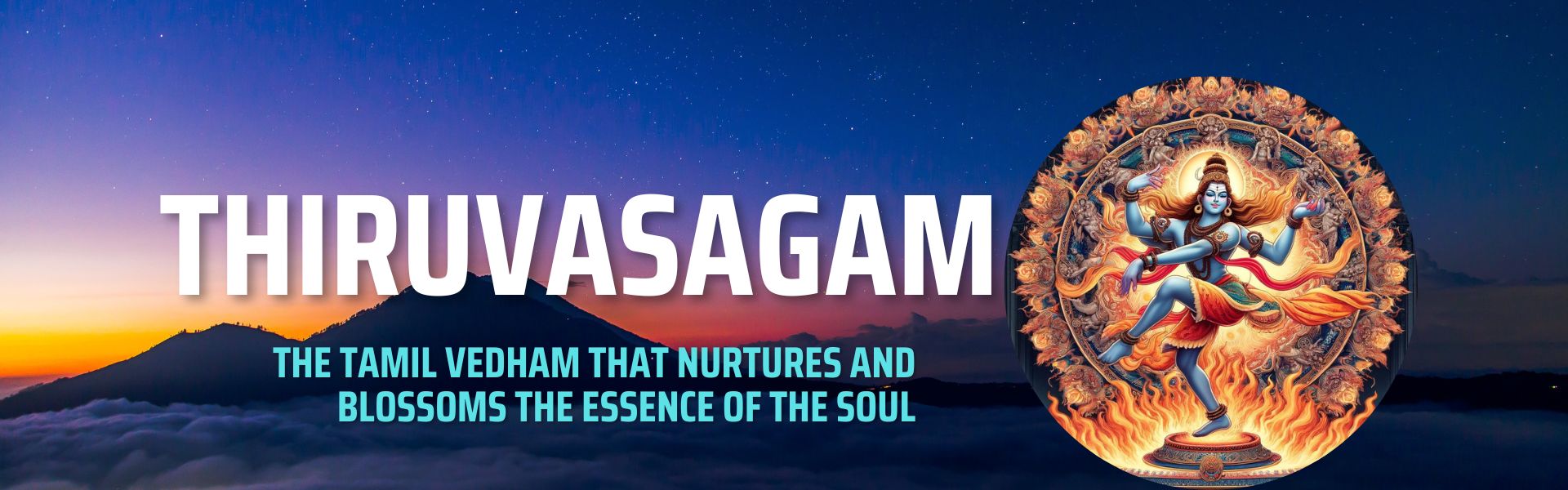
That is why, at the conclusion of singing the Thiruvasagam, in the holy shrine of Chidambaram, Manickavasagar, with his hand pointing toward the dancing Nataraja, said:
“Behold! That is the true essence of all this.”
And in that very moment, he merged with the divine light — his body dissolving into the supreme Shiva. What greater testimony is needed to prove that Thiruvasagam is a miraculous treasure of Brahma-gnana?
We humbly request all scholars and thinkers to reflect deeply on this.
Let the Thiruvasagam no longer remain confined within the boundaries of religious ritual. Let it also shine forth as a masterpiece of literary greatness — a scripture honored and celebrated by Tamil people everywhere.
Imagine a soul, tightly bound in the grip of darkness, seeking the Supreme Light of the cosmos — and moving toward the pinnacle of the divine sound Pranava. Along this path, it encounters various ecstatic spiritual experiences and truths, which are captured and expressed through these divine poems, in the clearest Tamil rhythms, as part of Manickavasagar’s life of deep realization and spiritual austerity.
A soul wandering in search of its own essence, finally catching a glimpse of itself, bursts into ecstatic poetry and divine dance — and that is how Thiruvasagam appears to us.
In one such instance, Manickavasagar himself says…
He who dwells in glorious Perunturai,
He has taken my very mind as His dwelling place, with joy—
Multiplying bliss, dispelling darkness,
Forever severing the chains of sorrow,
Shining as pure Light, and filling me with Love.
(Thiruvasagam – Verse 625)
What Makes Thiruvasagam Unique
Everywhere in Thiruvasagam, we see the states of divine bliss experienced when Lord Shiva takes over the devotee. We also see the helpless longing: What can I offer in return for such boundless grace?
The blissful dance of Shiva as He blooms within the soul…
The sacred sounds of Brahmananda (divine sound) that echo within the devotee’s head as Shiva dances…
All of these create a flood of divine joy.
When that divine dance ceases, the devotee laments:
- Has Shiva abandoned me?
- Has He turned away from me?
- Has He left me orphaned like a calf longing for its absent mother?
The resulting grief — unbearable sorrow, helplessness, and a desperate urge to die — is expressed in poems so intensely divine that they burn through us like fire. Such scenes are rarely found in any other scripture. Let us look at a few such verses:
“Who am I to approach His feet? He, who placed a throne for a wretched cur like me,
Entered this body of flesh, merged with my soul, and never parted from my heart—
The One with fragrant, matted locks, who dwells eternally in sacred Perunturai,
Has given me a treasure unknown even to the heavenly beings.”
(Uyir Unnip Patthu – 2)
“I will wear the fragrant konrai flowers, and adorn the shoulders of Shiva;
I will unite with Him, cling to Him, and lose myself in love;
I will quarrel with His red lips, then melt in devotion, and seek His feet in longing;
I will suffer, then blossom again—
And sing of the feet of the Fire-Dancer! O dear one, see this and rejoice!”
(Thiru Ammanai – 17)
“You gave me a state I could not understand;
Without knowing it, I fell.
You lack nothing—O Lord! Who else will accept this servant as Yours?
I could not even mingle with the devoted ones who praise You through ages.
My Lord! Separated, I suffer alone—
A guest to pain.”
(Anandha Malai – 2)
If there exists a literary work—a spiritual epic—that, with refined and noble words, conveys to our thoughts, our ears, our minds, and our very soul the qualities of both human and divine virtues, love, devotion, wisdom, truth, moral principles, and spiritual philosophy, then it is none other than Thiruvasagam. No one, from any land or culture, can deny this truth even to the smallest degree—this is a cosmic truth.
If one were to say that Thiruvasagam is the foremost of all world literatures, it would not be an exaggeration.
The messages conveyed in Thiruvasagam transcend time, place, and geography. They deal with the ancient inner essence that accompanies the soul through every birth—how this essence, which is bound by the three impurities (Mummalams), can be uprooted and burned away. It speaks of how a soul, realizing the divine thread of grace within, grasps it, follows its light, and merges with it. The verses describe the many types of spiritual awakenings that take place within such a soul.
These experiences are not meant for the author alone—they are shared with a motherly compassion so that all who study, chant, reflect on, and follow Thiruvasagam can attain the same spiritual joy and realization.
Thiruvasagam tells us:
- Why divine contemplation doesn’t arise naturally in human beings.
- Why, even when it arises, it doesn’t become complete.
- How to shower love upon the Divine.
- What strategies we must employ to seek and find God.
- How true devotion should be expressed.
- What bliss can be attained through such devotion.
- What obstacles stand in the way of realizing the Divine.
- How to overcome those obstacles.
- How to reach the soul once the obstacles are removed.
- What the all-pervading divine form of Siva is like once the soul is reached.
- How to unite with and merge into that divine form.
- How to celebrate a sacred marriage (symbolic union) with God once merged.
- What kind of Brahmastra Tapas (ultimate spiritual practice) is needed to marry the Divine.
- How to attain the highest wisdom (Brahma Jnana) through this Tapas.
- How to perform this Brahma Jnana Tapas beyond time—outside of day and night.
- Finally, it says that every soul and advanced spirit can live eternally in union with Sadasiva and the Supreme Brahman.
Thiruvasagam serves as a ladder for those in the mortal world to ascend to the celestial realm. For those who’ve attained this rare human birth and suffer due to the impurities of the world, Thiruvasagam provides the knowledge and spiritual techniques to overcome them. It becomes a refuge for seekers and a guiding light on the path of wisdom.
The radiant light that blossoms from the pure divine flame dispels darkness. Soaked in the grace of the Lord, reflecting upon His greatness, wisdom, and compassion, melting in devotion, the sacred hymns of Thiruvasagam, spoken from the heart, will remain eternal universal truths for countless eons.
Manikkavasagar’s only wish was this: That everyone who reads these hymns should experience the divine state of Siva he attained—and merge with God as light becomes light.
What makes Thiruvasagam so moving is the mature renunciation, love-filled yearning, and musical richness of its Tamil. As the saying goes, “He who is not moved by Thiruvasagam will not be moved by any verse at all.”
The true greatness of Thiruvasagam lies in its countless similes, allegories, and subtle metaphysical truths. When explaining profound truths, what better tool than a powerful metaphor?
Manikkavasagar, reflecting on his own experience, wished that his entire body would turn into eyes to weep in devotion. A hymn that captures this feeling appears in the 10th verse of the Thirupathigam section:
“What you gave me was your own self; what you took was my self—
O Sankara, who can fathom your grace?
I gained a boundless bliss with no end;
What did you gain from me, after all?
O Lord who took my heart as your temple,
Siva who dwells in the sacred Perundurai!
My beloved Lord, my Supreme,
You have taken residence in my very body—
But I have nothing to offer you in return.”
If Siva is to manifest in our body, then both Sound (Nada) and Light (Jyoti) are essential. Our ancestors represented sound through the conch (Sangu) and light through the serpent (Aran). When Siva reveals Himself, it is the serpent coiled at the gate of the supreme Pranava that guards and blocks entry. Hence, the word “Sankara” means Sangu (Conch) + Aran (Serpent-bearer).
When performing the Tapas of Brahma Jnana, the yogi sees the divine light emerge as a form of Siva within himself—that’s why he says:
“What you gave was yourself; what you took was my self.”
Since the Divine manifests within, the seeker is immersed in immeasurable bliss. But what can he possibly give in return? There is nothing greater than God. Therefore, he can give nothing. That’s why Manikkavasagar says:
“I gained bliss with no end—what did you gain from me?”
A human heart must be moved and melted. Such melting leads to spiritual awakening, which flowers into wisdom. If a person remembers God and weeps, Siva will surely reveal Himself within.
But will man do this?
Will he truly weep for God?
Thiruvasagam challenges us and shakes us awake, saying: “If you weep, you can attain God. This is certain!”
So let’s read a verse of wisdom that melts the heart:
“I am false, my heart is false, even my love is false—
Yet, O Lord, if this sinner weeps, can I not attain you?
O sweetness, nectar, pure sugarcane essence,
O my fawn-like Lord, grant me your grace,
That your servant may come and unite with you.”
(Thiruchathagam – Verse 90)
Manikkavasagar says, “If even I, a sinner, weep—I can reach you!”
But how can those of us, trapped by karma, weep and reach the Divine?
He says even our love is false, our minds are false. So how can we, living in such falseness, attain the Divine? That’s a fair question we all might ask.
The true answer lies not in logic—but in experience, love, and surrender. Let’s listen, reflect, and let our hearts melt.
May all beings live in bliss.
Thiruchitrambalam!