

Thiruvasagam – 02: The Tamil Veda That Awakens the Soul
May all living beings live in bliss.
Thiruchitrambalam (Sacred Chidambaram)
- Sivapuranam
(Revealed at Thiruperundurai – A unique introductory hymn)
Long live the sacred five-lettered mantra “Namashivaya”!
Long live the feet of the Lord!
Long live the feet of Him who never leaves my heart even for the blink of an eye!
Long live the feet of the Guru-jewel who ruled over Thirukokazhi!
Long live the feet of Him who stands as the Agama and draws us near!
Long live the feet of the One who is both the One and the Many, the Supreme Lord!
A Divine Conversation between Shiva and Manikkavasagar
Shiva: “Vadavoorar, your songs touch the innermost core of the heart. Why have you begun your hymn with ‘Namashivaya’? Among countless words, why have you chosen to begin with my five-lettered mantra? Why have you placed it above all?” Thus asked Lord Shiva, while inscribing the above five verses with a stylus on palm leaves.
Manikkavasagar replied:
“Lord, why pose such questions in the midst of a song born from the melting of my heart? Wouldn’t such questions disturb the essence of what flows? Instead, kindly keep writing as I sing. Please, no interruptions in between.”
Hearing this, would the One who resides in the South remain silent? He began conversing with Manikkavasagar again.
Shiva:
“Vadavoorar, you’ve started singing with the ecstasy of divine dance. Instead of the slow arrival of poetry, it now pours like a flood. The lines flow too fast for me to write neatly. I must press the stylus hard into the palm leaves to keep up, and my fingers ache. If you sing more slowly, I can keep writing without needing to ask questions.”
On hearing this, Manikkavasagar began to immerse himself within his very soul. He once again touched the abode of Shiva and began to surrender himself into the flame of divine radiance. A mystical union commenced.
The Meaning of Surrender
To surrender oneself means to merge into the light of one’s soul. Light and soul are not separate. If both are one, then is the soul also light? If so, how can we perceive this soul of light? Is it possible to see the soul? When we see the light, why can’t we see the soul? Are there answers to these questions? Thousands of such questions rolled within us, creating a poetic turbulence.
Explanation (Philosophical Commentary)
This universe is composed of the five great elements (pancha bhootas). The human body too is made up of these same five elements:
- Earth – represented by the letter “na”
- Water – “ma”
- Fire – “shi”
- Air – “va”
- Space (ether) – “ya”
Let these elemental syllables — “Na-Ma-Shi-Va-Ya” — flourish eternally. Let the sacred feet of Shiva flourish forever. Let the feet that remain ever unseparated from my heart, even in the blink of an eye, flourish. Let the feet of the radiant Guru-jewel who dispels darkness flourish. Let the feet of the Lord who embodies the essence of the Agamas (scriptures) and dwells within us flourish.
When engaged in deep penance, the Lord appears as the One. Yet, when blessing the beings of the world, He becomes the Many — pervading everything without separation. Let the feet of such a Lord flourish eternally.
True Knowledge (Jnana Insight)
Among all beings on Earth, man is the most evolved. Within the human body operate 96 principles (tattvas). The body is made of five elemental forces, and there exists a direct connection between these cosmic elements and the human form. Hence, humans can absorb and express these universal elemental powers. The five elements are closely connected with the five sense organs:
- Earth creates the body
- Water connects with the tongue
- Fire relates to the eyes
- Air governs the nose
- Space (ether) corresponds to the ears
To each of these elements, ancient sages associated a divine principle:
- Earth – Brahma
- Water – Vishnu
- Fire – Rudra
- Air – Maheshwara
- Space – Sadashiva
Because these sensory forces (indriyas) bring many benefits both in the material and spiritual realms, our ancestors called them “jnanendriyas” — organs of spiritual knowledge.
When man turns inward and uses his senses with awareness, he begins to realize the Self and attain higher wisdom. Since these sense powers and elemental forces are deeply entwined with the divine name, man internalized and associated the five-lettered mantra:
Na – Ma – Shi – Va – Ya
with
Earth – Water – Fire – Air – Space
That is how the chant Namashivaya began.
As man chanted it, a wordless spiritual awakening arose within him. The internal transformations caused by chanting led him toward realization and truth.
That is why Manikkavasagar, in the divine state of spiritual awakening granted by the Lord, began his hymn with “Namashivaya Vaazhga” (Long live Namashivaya) — because these sense-empowering syllables became the very root of his spiritual expression.
Verse from Thiruvasagam (2038)
“The five elements surged forth, spreading out their brilliance.
They were bound and locked within the chariot of knowledge.
In the divine chariot named ‘Ananda’ (bliss),
It is His grace alone that adorned the path above.”
Explanation:
The five elements, representing the five senses, naturally tend to flow outward. Hence, they are said to have “surged forth.” But through divine grace, their outward flow is restrained and they are drawn inward, bound and locked within the chariot of wisdom, which refers to awareness of the divine feet (Shiva consciousness) that never fades.
To lock them means to focus inward through devotion, especially by chanting the sacred Tamil mantra “Siva Siva”, which is considered the primordial sound of the ancient Vedas. Those who travel this inner path are graced by Lord Shiva, who bestows upon them the ultimate bliss — the joy of union with His divine feet. This union with the feet of the Lord is the highest form of spiritual attainment and leads to a life of supreme fulfillment.
This path is attained by mastering the five senses and turning them inward.
Verse from Thiruvasagam (2042)
“The steady mind within contains the whole universe,
Yet none are aware of the five that torment from within.
People laugh and speak in ignorance,
But it is the dark mountain of ego, ringed with illusion, that binds us.”
Explanation:
Lord Shiva manifests His divine form within the temple of the body, using maya (illusion) as His stage and sacred ash (vibhuti) as His grace. This is likened to the devotee seated in front of the deity within a sacred temple.
Here, the temple is the body, vibhuti represents divine grace, and the body itself is none other than Shiva.
This aligns with the great scriptural verses:
- “He became the son of Hara with the same body”
- “The Lord created this flesh-body separately and instantly destroyed it.”
In this view, the body is called ‘Sakalam’ (the whole) — the base or the seat of Shiva’s subtle presence (Shiva-k-kuzhandhu, the tender flame of Shiva).
The devotee’s heart rests in this divine presence and rejoices.
However, no one realizes that the five senses, which are constantly pulling outward, are the true inner enemies.
Instead, people make light of spiritual truth with laughter and empty words, not knowing that it is the mountain-like darkness of ego, surrounded by illusion, that causes our suffering and entrapment in the cycle of birth and death.
Further Explanation of the Terms and Symbolism:
- Parvati, who is the embodiment of divine sound (Para Nada Shakti), is eternally united with Lord Shiva, who is the embodiment of pure form.
Thus, Shiva is referred to as “Natha” (Lord of Sound). - Thiruperundurai, where these hymns were revealed, is also known as Kokazhi.
The place name “Kokazhi” comes from “Ko” meaning Lord, “Kazhi” referring to the space or field — the sacred place adorned with divine symbols like the staff (danda) and discus (chakra). - The divine feet of the Lord are referred to as “chakra”, and the fingers as “danda” by the realized sages.
The Chinmudra Gesture and Its Deeper Meaning:
During Brahma-jnana (the knowledge of the Supreme), the fingers and chakras of the body are employed.
When Lord Shiva imparted this supreme knowledge to sages like the Sanaka rishis, He showed the Chinmudra gesture with His hand — using His fingers to indicate the path to grasp the divine feet for attaining realization.
Important Note: The Chinmudra is not merely a meditative hand pose placed on the knees during penance, but a symbolic pointing toward the divine feet of Shiva.
In Chinmudra:
- The index finger (individual self) and thumb (universal self) are curved to touch each other, forming a circle.
- The other three fingers (representing the mind, intellect, and ego) are extended.
This circle formed by the joined fingers is the symbolic shape of Shiva’s feet.
Therefore, in sacred art and statues, when deities are shown displaying Chinmudra, it is a spiritual message:
“Grasp the divine feet. There lies your liberation.”
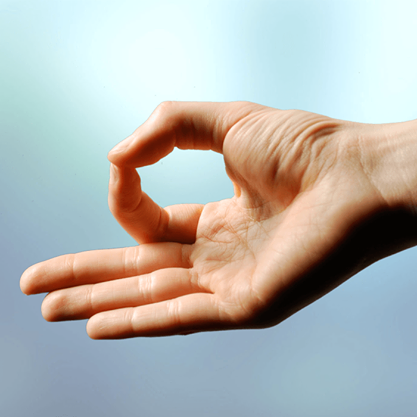
Chinmudra = The Divine Feet
Verse from Thiruvasagam (1956):
“From the higher subtle plane arise the Bindu (point) and Nada (sound);
Guided by the sacred staff along the path marked by the Guru’s instruction,
When one drinks the milk-like nectar that is the Bindu, detached from all attachments,
Then the illusion of worldly bondage fades and dissolves;
That very Bindu is the source of all delusion, and it is dissolved.”
Interpretation:
- The Bindu (drop/point) and Nada (primordial sound) originate from the higher planes of consciousness, referred to as “Superior Ground” or “Transcendental Realm”, which is beyond the six chakras and even above the Sahasrara (crown chakra).
- These subtle energies are carried through the central energy channel (Sushumna Nadi), guided by the subtle staff (spinal channel), and in accordance with the Guru’s instructions (“Kuri” – the mark or direction shown by the Guru).
- If a seeker drinks the nectar-like essence of the Bindu with complete detachment, then all illusions and delusions (the cause of repeated births) completely dissolve.
- This Bindu itself, which once fueled the cycle of delusion and worldly pleasure (Māla, or spiritual ignorance), ceases to exist.
- “Moolam” – Refers to the base (root chakra), the starting point.
- “Melā Nilam” – The higher state of consciousness, beyond all material support.
- “Kōlāl” – The subtle energy path or staff (symbolic of the spine or Sushumna).
- “Kuri” – The path shown by the Guru.
- “Māla” – Spiritual ignorance or delusion.
- “Mālum” – Dissolves, fades away.
On the Role of Pranava and the Bindu-Nada Origin
- Without the support of Pranava (the sacred syllable ‘Om’), one cannot attain Shiva.
- Here, Pranava is symbolized as the Meru Mountain – the sacred spiritual axis.
- The Agamas (scriptures on Shiva worship) are built around this Meru, meaning that all rituals and yogic paths are centered around Pranava.
- The word “Agamam” (scripture) comes from “Agamam” = Meru, i.e., the Meru represents the inner mountain of realization.
- All deities, divine powers, and the cosmos are subtly embedded within this Pranava Meru.
- Shiva resides at the pinnacle of this Pranava.
His divine feet (energetic support and consciousness) are manifested within all beings.
Hence, Manikkavasagar sang:
“Long live the feet of the One who stands as the Agama (Pranava), drawing us near.”
On Shiva as Both One and Many
When Shiva is in the formless state (Arupa), He appears as One (Ekan) — distinct and singular.
But when He takes form (Rupa) and expresses through all beings, He is seen as Many (Anekan) — all-pervading.
Thus, Manikkavasagar says:
“Long live the feet of the One, the Many, the Lord Supreme.”
Chinmudra Equals the Divine Feet
The gesture known as Chinmudra — formed by touching the index finger (individual self) and thumb (Supreme Self) together — is symbolic of Shiva’s divine feet.
It is not just a yogic hand pose to rest on the knees during meditation. Instead, it symbolically points toward grasping and surrendering to Shiva’s feet.
When sages like Sanaka and Sanandana sought Brahma-Jnana (supreme wisdom), Shiva revealed Chinmudra with His fingers, not as a meditation posture, but as a sacred instruction:
“To attain Brahma-jnana, hold onto My divine feet.”
The curved shape of the Chinmudra is the symbolic representation of the Lord’s feet.
That is why sacred images and deities depicted in Chinmudra are actually giving the message:
“Cling to the divine feet – that is the path to liberation.”
May all beings live in bliss!
Thiruchitrambalam!